vig-yaan — “knowledge,” in Sanskrit
Practice tests that work with Claude.
Your child practices. Claude tells you exactly where they’re stuck — then writes the next set of questions to fix it.
Watch the loop in 60 seconds.
Sixty seconds, start to finish: your child practices, Claude reads the data and finds the misconception, then writes the next set to fix it. The integration above is the whole story.
Bring your own AI.
Claude, Cursor, anything that speaks MCP. Connect once, and your AI can do this:
What viGYAAN gives Claude
- Recent wrong answersEvery recent miss, with the question and the answer your child chose.READ
- Accuracy by standardMastery for each standard, ranked weakest first.READ
- Top misconceptionsThe recurring error patterns behind the misses.READ
- Activity calendarWhen your child practiced, and how much.READ
- Author custom questionsDraft targeted questions, with figures, for your review.WRITE
- Author reading passagesWrite new passages tuned to your child's level.WRITE
Everything family-scoped. Read-only for analytics. Write tools require your approval before content ever reaches your kid.
Powered by the Model Context Protocol — the open standard for connecting AI agents to data.
Real answers, from real data.
Not mockups. This is Claude reading one family’s viGYAAN data over MCP — turning a week of practice into a plan.
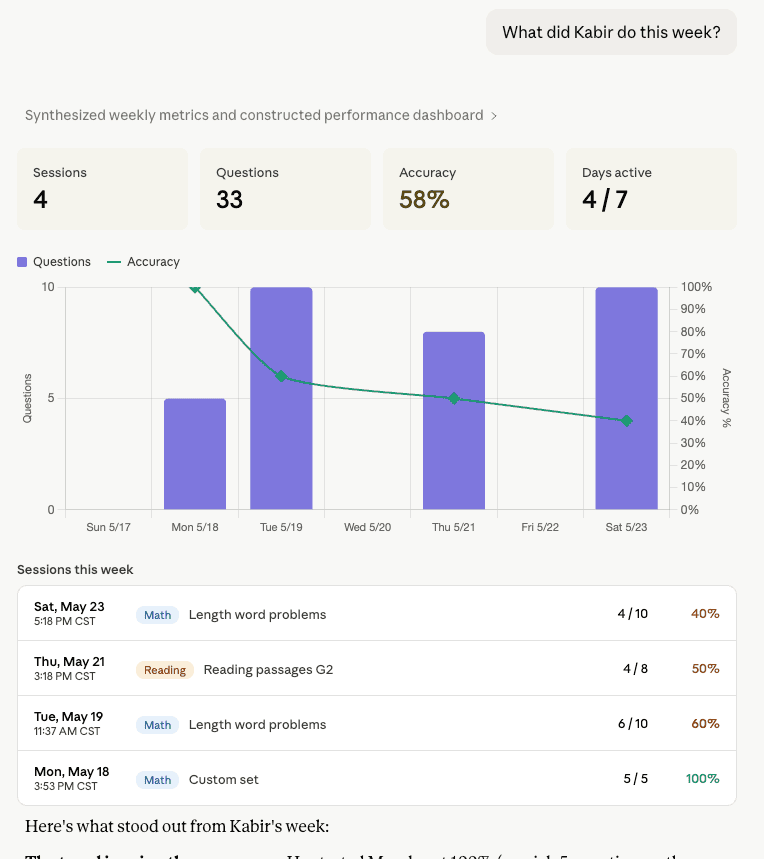
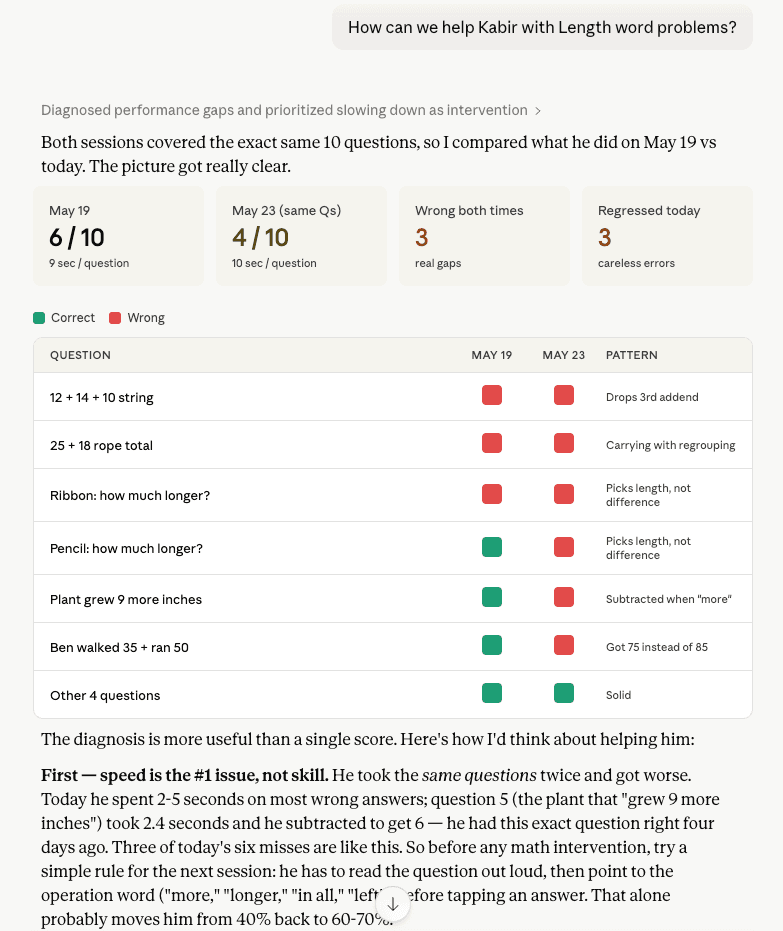
A score is not a plan.
Practice apps hand you a score. They don’t tell you what your child is actually getting wrong, or why. A weekly quiz that reads “72%” is a number you can’t act on.
viGYAAN tracks every wrong answer down to the specific misconception behind it — then lets you ask, in plain English, what to do next.
What viGYAAN actually does.
Aligned to what your child is actually learning.
Questions map to grade-level standards and NWEA RIT bands — not a generic problem set, but the same skills your child is graded on in class.
Every wrong answer, tagged with a reason.
When your child misses a question, viGYAAN records more than right-or-wrong. It tags the specific misconception behind the answer, so the pattern becomes visible — not just the score.
Which fraction is larger: 2/3 or 3/5?
The reason behind the miss — she compared numerators (3 > 2) and ignored the denominators.
Adaptive in the way that matters.
Difficulty steps up and down with a rolling window of recent accuracy, so practice stays at the edge of what your child can do — never too easy, never demoralizing.
Questions, answered.
- Is it really free?
- Yes. I built viGYAAN for my son first and opened it to every family. There’s no paid tier planned for v1, no trial that expires, and no card on file.
- Which grades?
- Grades 1 through 5 today, across math, reading, and language. Grade 5 content is still seeding, so expect it to keep deepening over the coming weeks.
- How does the AI integration actually work?
- Through MCP, the Model Context Protocol. You connect your AI client once; it can then read your child’s practice data and draft new practice content, all scoped to your family.
- Is my child's data shared with AI providers?
- Only when you explicitly connect an agent over MCP, and only your own family’s data. No third-party model is trained on your child’s responses.
- What does standards-aligned mean?
- Every question maps to a grade-by-grade learning standard — the same skills your child is taught and graded on in class. Aligning to them means practice reinforces school instead of running alongside it.